Colony monitoring
Your bees will tell you
they are in trouble.
A colony holds its brood nest at 35 °C — through frost, through midday sun, without a thermostat. When it can no longer do that, something is already wrong. This kit watches for that moment every minute, without opening the hive.
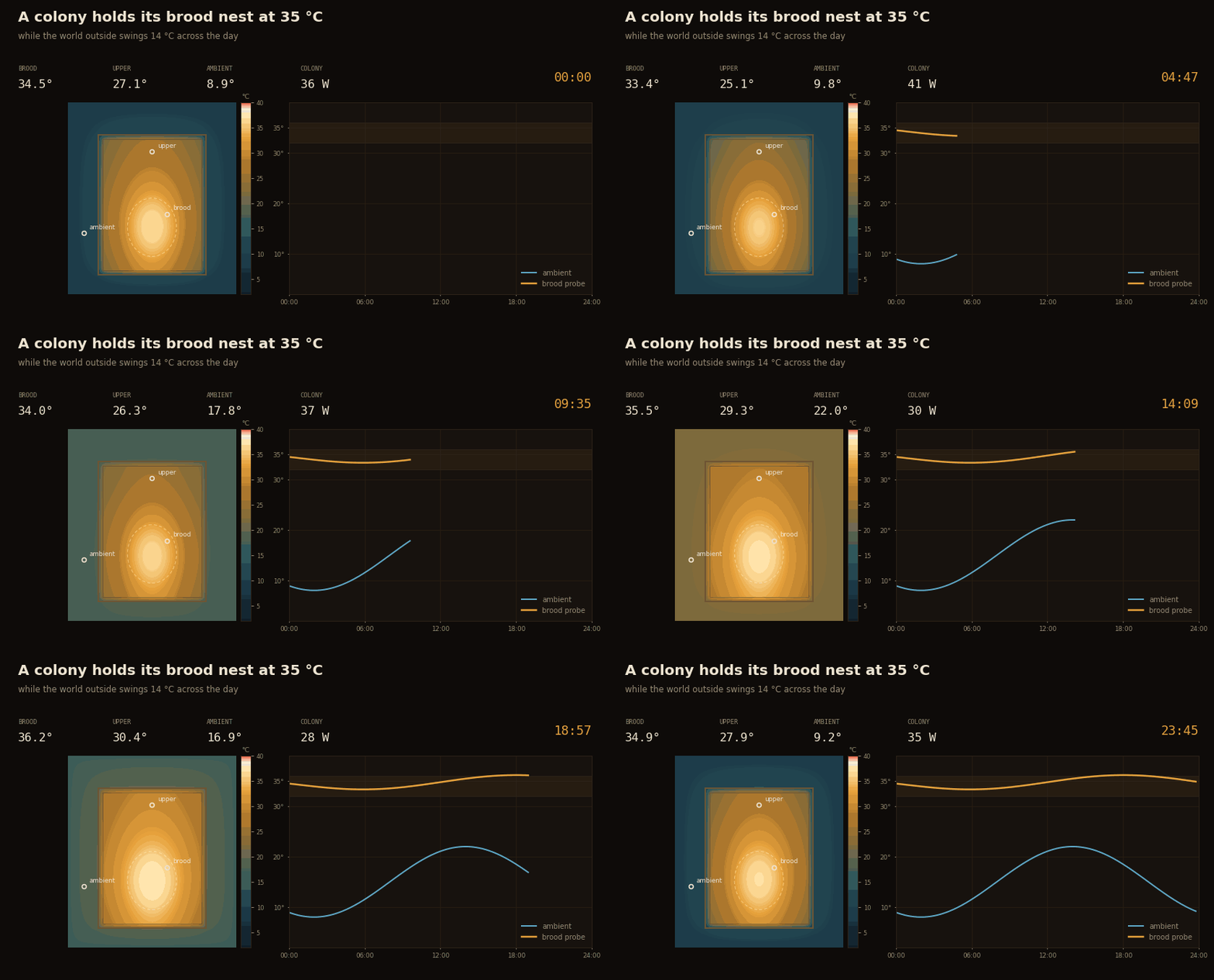
An inspection is a snapshot.
Failure is a process.
You open a hive every week or two, and for the fortnight in between you are guessing. Opening it is not free either — you break the propolis seal, dump the heat the colony spent days building, and put the queen at risk every time.
By the time trouble is visible on the frames, it has usually been developing for weeks. A failing queen, a colony slipping toward queenless, a nest that has quietly gone broodless: these are slow. They are visible in temperature long before they are visible on a frame — and over winter, when you cannot open the hive at all, they are invisible until spring.
Thermal stability is the vital sign
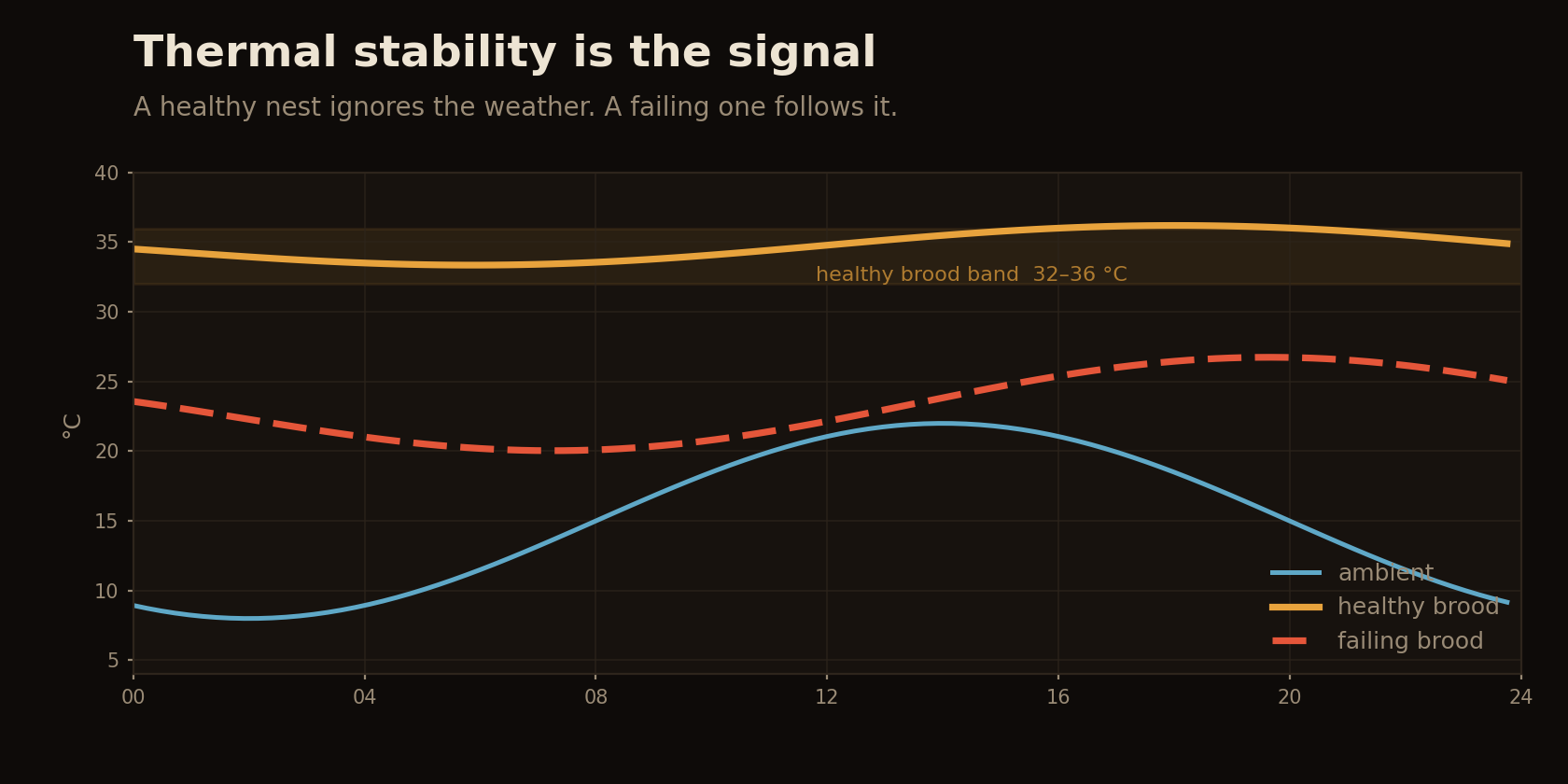
A queenright colony with healthy brood defends 35 °C hard, because developing brood needs it. A colony that is weakening, broodless, or has lost its queen stops defending it. The nest stops being a regulated system and starts being a box that follows the weather.
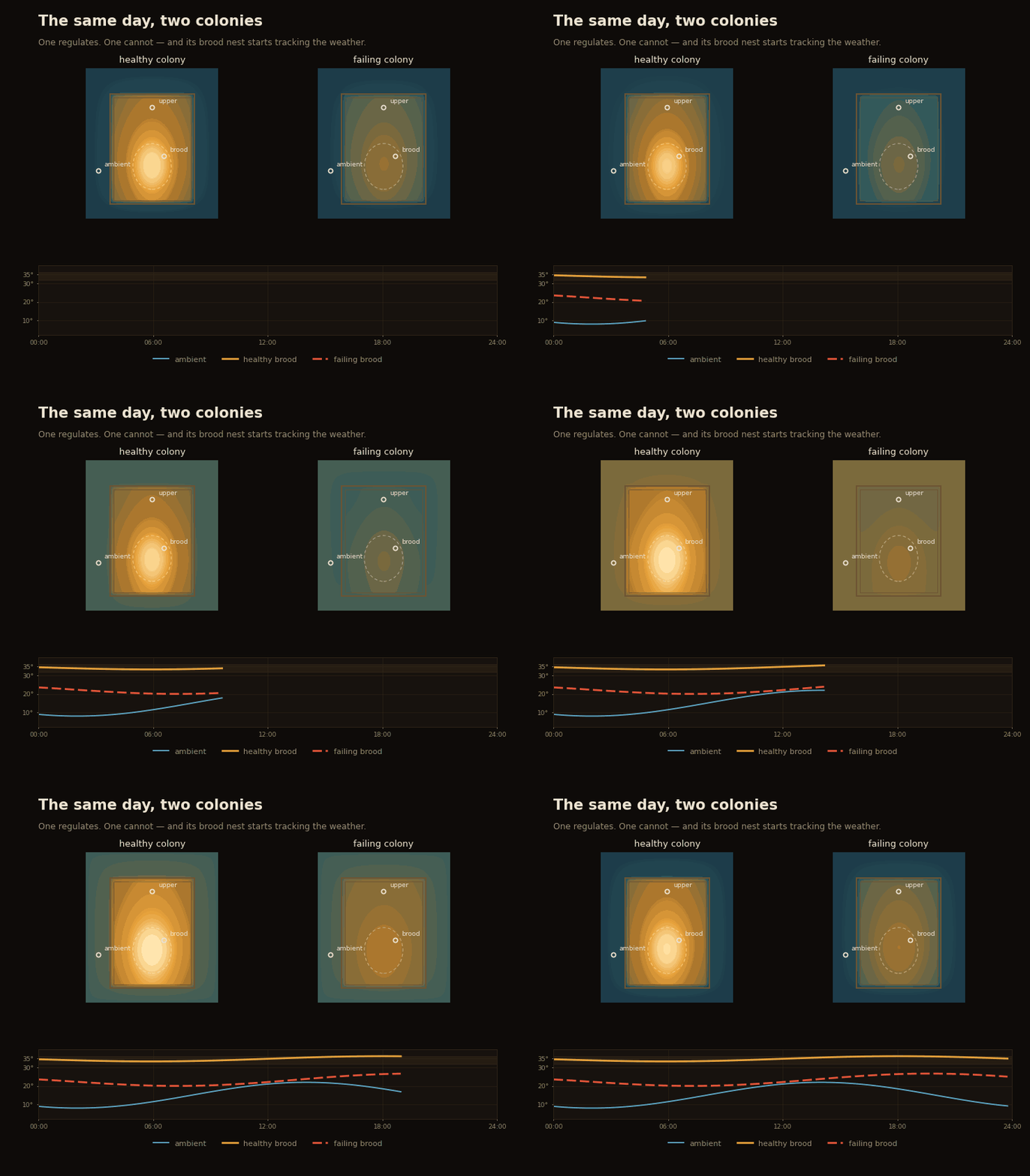
This is why the system watches trends and baselines rather than fixed trip points. A single temperature reading tells you very little. The relationship between the nest and the weather, tracked minute by minute, tells you a great deal.
What the kit measures
- Cadence
- 60 severy channel, continuously
- Temperature
- 3 probesnest edge, upper, ambient
- Humidity
- 2 sensorsin-hive and ambient
- Weight
- 4 cellsplatform scale under the hive
- Live on your phone. Every hive on a map, coloured by its worst active alert.
- Alerts that reach you off-cadence. A colony crossing a threshold publishes immediately rather than waiting for its next slot, so an alert edge is never lost.
- Survives your patchy apiary WiFi. Readings are buffered on the device through an outage and replayed with their original timestamps — lossless up to about four hours.
- Tells you when a sensor is lying. A dead probe is reported as a fault, never quietly substituted with a plausible-looking zero.
- Around $82 in parts. That is the actual bill of materials, not a target price.
Readings are cheap. Judgement is the product.
Anyone can put a thermometer in a hive and draw you a chart. The work is in deciding which wiggle in that chart is worth your Saturday morning — and the system splits that decision between the device and the server, according to which one is actually better placed to make it.
The device calls what only it can see
Battery state, where an absolute threshold is genuinely correct — 3.3 V means the same thing on every hive. And stuck sensors, caught on raw repeated samples, because once a reading has been smoothed a dead probe looks perfectly plausible.
The server calls what needs history
Every channel is compared against its own rolling baseline, not a number someone picked. A strong colony in an exposed apiary and a nuc in a sheltered garden do not share a threshold, and pretending they do is how you get an alert nobody trusts.
Time of day is part of normal
Thresholds follow a diurnal profile, so an ordinary warm afternoon does not page you. The question is never "is this hot" — it is "is this hot for this hive, at this hour".
- Channels are read together, not in isolation. Brood temperature and humidity drifting at the same time is a different and more serious signal than either one alone — that is the ventilation alarm, and it only exists if you correlate.
- Alerts fire on the edge and clear explicitly. One alert per episode, raised when the condition starts and closed when it ends. No hourly re-notification for a problem you already know about.
- You can acknowledge one. Tap it and the hive stops shouting, but stays flagged until the condition actually clears — so "I know" and "it is fixed" stay different states.
- Faults are first-class. A dead channel reports as unmeasured with a fault code, never as a plausible-looking zero, and the other channels carry on working. A hive with one broken probe is not a hive you stop hearing from.
Built for an apiary, not a hive
One backend runs as many hives as you have. Each unit publishes under its own identity, and the map shows the whole yard at once, coloured by whichever colony is in the most trouble — so the daily question stops being "how is everything" and becomes "who needs me first".
Adding a unit is a registration, not a rebuild
Register a hive and it hands back that unit's configuration. No editing firmware per device, no keeping a spreadsheet of which board went where.
Every unit knows what it is
Pins, sensors, battery layout and calibration live in a hardware manifest the firmware builds itself from. A different variant of the kit is a different manifest — not a fork of the codebase.
Calibration survives the winter
Each unit stores its own scale calibration and knows which physical probe is which by serial number, so a probe unplugged and put back in the wrong order still reports the right thing.
Learn the judgement before you own the hardware
The kit ships with a training mode: an apiary of several hives, telemetry streaming in, problems developing quietly, and a limited number of inspection visits per day. You decide who to open.
It runs on the same detection code the real deployment uses, so the alerts you learn to read are exactly the ones you will get in the yard — and it is an honest way to find out whether this kind of monitoring suits how you keep bees, before anything is bolted to a hive.
Questions it is built to answer
- Is the brood nest thermally stable?
- Is the colony ventilating normally?
- Is nectar coming in — and are stores being consumed too quickly?
- Is there an overheating risk building?
- Is there thermal instability suggesting broodlessness, weakening, or a queen problem?
- Is a sensor or comms fault hiding a real colony issue?
The hive stays a good hive
Most of the design decisions here were made by asking what is good for the colony, not what is easy for the electronics.
Electronics are guests
The enclosure mounts beside or below the hive, never on top. The top is your inspection access and it stays clear.
Minimal intrusion
A 3 mm probe at the edge of the brood nest, not its centre. Nothing sits where it would disrupt thermoregulation, ventilation, or the queen's laying pattern.
Sensing, not actuation
The system does not heat, cool, or ventilate your hive. It tells you what the colony is doing and leaves the beekeeping to the beekeeper.
Designed, not yet built
Things we have worked out on paper and deliberately have not shipped. They are here because a roadmap you can read is more useful than a feature list you cannot verify — nothing in this section exists yet.
| Idea | Where it has got to |
|---|---|
| Hive theft and tamper alerts | Specified as a separate low-cost unit — tilt and movement sensing, SMS-first so it works where there is no WiFi. Deliberately not a monitoring device: it carries no brood or mass sensors, because the job is a fast alert on a long battery. |
| Out-of-range apiaries | A cellular uplink for yards with no WiFi, with a data budget that does not quietly cost you a fortune. Designed, not built. |
| Unattended running | Solar, so a unit survives without a monthly battery swap. The current firmware runs its radio continuously and needs charging roughly daily — honest, and the reason this one matters. |
| Listening to the colony | Colony sound carries real information about queenlessness and swarm preparation. The sensing approach is written up and the field is reserved in our data format, but there is no microphone, no driver and no analysis yet. We would rather say that than imply otherwise. |
Where this actually is
Being straight with you, because you will find out anyway and the whole product is about not hiding things.
| Component | State |
|---|---|
| Sensor firmware, alert rules, on-device buffering | Built · tested |
| Baseline anomaly detection and adaptive thresholds | Built · tested |
| Backend, live feed, alert history, browser monitor | Built · tested |
| Multi-hive registration and device provisioning | Built · tested |
| Apiary triage training mode | Built · tested |
| Mobile app — hive map and alert status | Built · early |
| Bill of materials and build guide | Complete |
| Field deployment on a live colony | Not yet |
Everything above the last line is built and tested in software. The last line is the honest one: no unit has yet run on a real hive. That is the next step, and it is what the pilot programme is for.
We are looking for pilot apiaries
If you keep bees and you would like a colony instrumented, we want to hear from you. You get the hardware and the data. We get the thing we actually need, which is a real hive, in real weather, telling us where the model is wrong.